
Power, permits and PDX. In addition to broadband and fiber, we learned a lot about these topics during this year’s Congressional Broadband Tour, hosted by the Foundation for Rural Service (FRS). The tour invites congressional staff members to learn more about broadband and the important role it plays in rural communities.
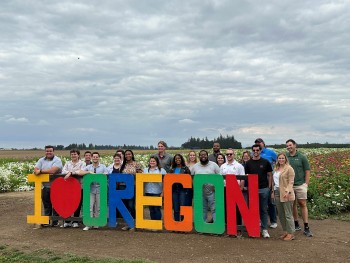
This year, 21 bipartisan staff members from personal offices and committees in the House and Senate traveled to Portland, then through southwestern Washington and northwest Oregon for three packed days. Joining us for the entire tour were Betty Buckley, executive director of the Washington Independent Telecommunications Association, Brant Wolf, executive vice president of the Oregon Broadband Association, and Jennifer Benson, NTCA member relations manager.
We started as soon as we landed at Portland (PDX) airport, where we received a briefing about the recent $2.15 billion facility renovation which opened to the public the next day. From there, we bussed to Toledo, Wash. to visit NTCA member company ToledoTel and Dale Merten.
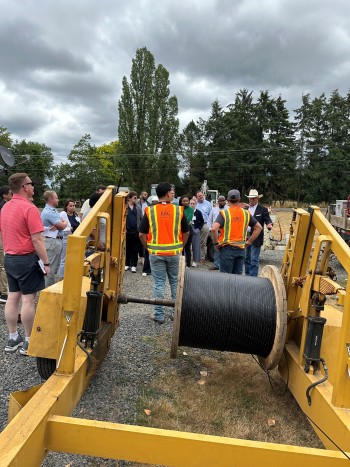
Dale showed the staffers a fiber installation project in a local neighborhood and then a fiber splicing demonstration at the central office. We also visited a local health center that expanded its telehealth services thanks to broadband provided by ToledoTel.
The next day we visited Ken Johnson and his team at WWest (Rosburg, Wash.), where we learned about permitting challenges slowing down a project to bring fiber across a bridge and on to an island. It was hard to pull the staffers away from the beautiful Columbia River, but we moved farther downriver to hear about the Port of Kalama and how broadband allows the port to be the second largest exporter on the West Coast and the 15th largest exporter in the United States.
From there, we continued along the river to the Bonneville Lock and Dam for a tour by the U.S. Army Corps of Engineers. The facility in Oregon was the first federal lock and dam on the Columbia and Snake Rivers, and the project’s first powerhouse, spillway and original navigation lock were completed in 1938 to improve navigation on the Columbia River and provide hydropower to the Pacific Northwest. Today, the project is a critical part of the water resource management system that powers generation, navigation, water quality improvement and a fish and wildlife habitat, including fish passage and recreation along the Columbia River. I was impressed by the size of the turbines in the powerhouse, the flow of water over the spillway and the systems in place to protect and preserve salmon and other fish (who knew the ecological benefits of lamprey, terrifying looking jawless fish that bear a strong resemblance to the creature in the Alien movie?).
But wait, we still weren’t done for that day! Another hour in the bus and we were at Mt. Meadows Ski Resort on Mount Hood, where Matt Day from Reliance Connects (Estacada, Ore.), shared how his company brought fiber halfway up the mountain to provide service not only to the ski resort but also to a hospital and other services at the location. These days ski resorts rely on broadband for their staff communications, point of sale operations and even reading the RF tags in the lift passes.
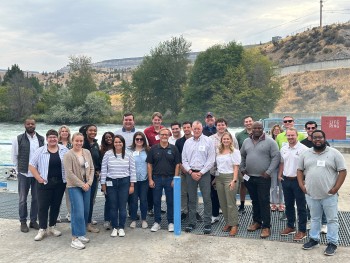
The final full day started with a visit with Tim York and Warm Springs Telecom on the Warm Springs Reservation. The reservation is vast and covered in terrain that makes it difficult to bury fiber underground. The company was, however, able to run fiber through an active dam on the reservation to expand their services. On the bus ride the group heard from John Cannon of Rally Networks (Mt. Vernon, Ore.), on the unique challenges of a company that provides broadband service in multiple states with different permitting, funding opportunities and levels of leadership from state broadband offices.
The second stop was in charming Bend, Ore., and a tour of the DirectLink data center by Paul Hauer. While there we also received a briefing by researchers at Oregon State University who use the facility to store petabytes (1,000 terabytes) of data for a world-wide oceanographic study. After talking about oceans and lunch, we bussed through miles of wilderness ravaged by recent Oregon fires to visit a local lumber mill that receives its broadband service from Stayton Cooperative Telephone Company (SCTC; Stayton, Ore.). The mill, Freres Lumber, supplied their patented laminated lumber product for the new PDX airport renovation.
Our tour ended with a beautiful dinner at the Wooden Shoe Tulip Farm, hosted by the farm’s owner Barb Iverson, chair of Monitor Telecom (Woodburn, Ore.) and Geri Fraijo, Monitor’s CEO. Other board members and staff from both Monitor and Molalla Communications (Molalla, Ore.) got to meet with the staff members and share their experiences about living and working in a rural community. Also joining the dinner was Daniel Holbrook from the Oregon State Broadband Office.
The next morning, we said goodbye to Washington and Oregon, but not before admiring the new PDX airport and sharing photographs from our speedy tour of the region. Due to the House and Senate Ethics Committee rules, the trip is limited to 72 hours from the time we touched down to taking off again – not much time when you are trying to highlight the good work made possible by NTCA member companies and the broadband they provide. This annual trip is only possible with the invaluable help from those on the ground, especially Betty Buckley and Brant Wolf. Thank you for your great ideas, connecting us with the people who showed us interesting things and all-around cheerful support of the tour.
The 2024 Congressional Broadband Tour was many hours on a bus, nights in budget hotels and efforts to keep a group of curious and informed staff members on schedule, but I cannot wait to do it all over again next year in a different state. During the tour, one of the staff members –who is extremely knowledgeable about broadband and rural communities – leaned over to me and said, “I’ve been working on broadband policy for a few years now, and this is the first time I’ve actually seen fiber or broadband instillations in person!” There is no substitute for seeing and experiencing NTCA member companies and your communities in person. Thank you for the opportunity.
The Congressional Broadband Tour is possible thanks to generous gifts from members of NTCA—The Rural Broadband Association, including NCSC (formerly RTFC).